This site will no longer be updated. For new posts, please visit: usfdalawyer.com.
Wednesday, November 3, 2021
Friday, May 20, 2016
FDA Finalizes New Nutrition Facts and Supplement Facts Labels
The FDA today announced a major redesign of nutrition facts label for packaged foods - the first such update in 20 years.
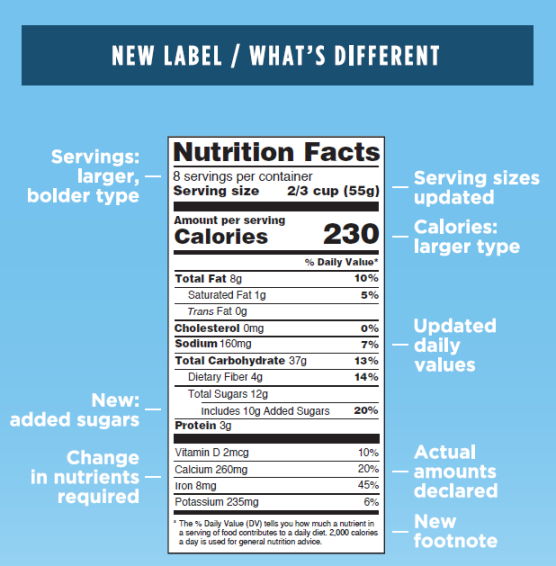
The new design will make the "calories" and "servings" information more obvious and include a new line for added sugar (in grams and as percent Daily Value). It will also update serving sizes that are more in line with amounts that people actually consume.
"Total Fat," "Saturated Fat," and "Trans Fat" will continue to be required but "Calories from Fat" is being removed.
Vitamin D and potassium will be required on the label. Calcium and iron will continue to be required. Vitamins A and C will not be required but may be included.
The daily values for nutrients like sodium, dietary fiber and vitamin D will be updated.
An abbreviated footnote for the %DV.
Manufacturers will need to use the new label by July 26, 2018. However, manufacturers with less than $10 million in annual food sales will have an additional year to comply.
The supplement facts panel will also have minor updates to reflect the changes in the nutrition facts panel.
The new design will make the "calories" and "servings" information more obvious and include a new line for added sugar (in grams and as percent Daily Value). It will also update serving sizes that are more in line with amounts that people actually consume.
"Total Fat," "Saturated Fat," and "Trans Fat" will continue to be required but "Calories from Fat" is being removed.
Vitamin D and potassium will be required on the label. Calcium and iron will continue to be required. Vitamins A and C will not be required but may be included.
The daily values for nutrients like sodium, dietary fiber and vitamin D will be updated.
An abbreviated footnote for the %DV.
Manufacturers will need to use the new label by July 26, 2018. However, manufacturers with less than $10 million in annual food sales will have an additional year to comply.
The supplement facts panel will also have minor updates to reflect the changes in the nutrition facts panel.

Wednesday, January 21, 2015
FDA Releases Draft Guidances on Wellness Medical Devices and Accessories
The FDA issued two draft guidances on January 20 outlining its approach to regulating low-risk devices intended to promote general wellness as well as medical device accessories.
In the draft guidance General Wellness: Policy for Low Risk Devices, the FDA states that it will not regulate a general wellness product. However, such a product becomes a medical device subject to FDA regulation when it refers to its use for a specific disease or condition and that application is invasive or goes beyond the general goals of most wearables (e.g., help people monitor their exercise, food consumption and heart rate).
treat or diagnose obesity;
treat eating disorders, such as anorexia;
help treat anxiety;
diagnose or treat autism;
treat muscle atrophy or erectile dysfunction;
restore a structure or function impaired due to a disease.
In the draft guidance General Wellness: Policy for Low Risk Devices, the FDA states that it will not regulate a general wellness product. However, such a product becomes a medical device subject to FDA regulation when it refers to its use for a specific disease or condition and that application is invasive or goes beyond the general goals of most wearables (e.g., help people monitor their exercise, food consumption and heart rate).
Specifically, devices that claim any of the following are NOT general wellness devices according to the draft guidance:
In the draft guidance Medical Device Accessories: Defining Accessories and Classification Pathway for New Accessory Types, the FDA states that it will regulate medical device accessories based on the risks they present when used with their parent devices, and not automatically based on the risks of their parent devices.
The public has 90 days to submit comments regarding the two draft guidances.
Wednesday, June 25, 2014
FDA Issues Draft Guidance Regarding MDDS
The FDA has released draft guidance last Friday, stating that the agency considers medical device data systems (MDDS) to be safe and effective, and does not intend to regulate them.
According to the guidance, the FDA will not mandate compliance to controls related to MDDS, including registration, premarket review and postmarket reporting, if they do not aim to control or alter the function of any connected medical devices, but rather are intended to:
According to the guidance, the FDA will not mandate compliance to controls related to MDDS, including registration, premarket review and postmarket reporting, if they do not aim to control or alter the function of any connected medical devices, but rather are intended to:
- Facilitate electronic transfer or exchange of medical device data;
- Store and retrieve medical device information, such as blood pressure data;
- Convert medical device data from one format to another; and
- Display medical device information.
Comments for the draft guidance will be accepted through August 19th.
Thursday, February 27, 2014
FDA Proposes Updates to Nutrition Facts Labels on Food Packages
The FDA proposed several changes to the Nutrition Facts label for packaged foods today. The FDA also proposed to make corresponding updates to the Supplement Facts label on dietary supplements.
Some of the changes being proposed by the FDA would:
Some of the changes being proposed by the FDA would:
- Require information about the amount of "added sugar" in a food product.
- Update serving size requirements to reflect the amounts people currently eat. (For example, changing the serving size of ice cream from half a cup to a full cup.)
- Require the declaration of potassium and vitamin D. Vitamins A and C would no longer be required on the label.
- Revise the Daily Values for a variety of nutrients such as sodium, dietary fiber and vitamin D.
- Remove "Calories from Fat" from the label.
- Update the format to emphasize certain elements.
Thursday, January 16, 2014
FDA Issues Guidance to Clarify Requirements for Beverages v. Liquid Dietary Suppelments
The FDA published two final guidance documents to help industry determine whether a liquid food product is properly classified as a dietary supplement or as a beverage, and to remind the industry of legal requirements regarding the substances that may be added to either type of product.
One of the guidances - Distinguishing Liquid Dietary Supplements from Beverages - describes the factors that characterize liquid products that are dietary supplements and those that characterize beverages that are conventional foods. Such factors include product claims, names, packaging, serving size, recommended daily intake, conditions of use, and product composition, as well as statements or graphic representations in labeling and advertising.
The second guidance - Considerations Regarding Substances Added to Foods, Including Beverages and Dietary Supplements - reminds the industry of requirements in the Federal Food, Drug, and Cosmetic Act that apply to substances added to both conventional foods, such as beverages, and to dietary supplements.
Why does it matter whether a food is a beverage or a dietary supplement?
All ingredients intentionally added to conventional foods or beverages are considered food additives. Food additives must either be approved by the FDA, deemed generally recognized as safe (GRAS), or otherwise exempted. A company may self-affirm the GRAS status of a food ingredient in its product(s). It is not mandatory for the company to submit a self-affirmed GRAS report to the FDA, however, it must be prepared to do so upon the FDA's request. Further, the costs associated with GRAS determinations can run upwards of $75,000 to $100,00 per ingredient.
Ingredients in a dietary supplement, on the other hand, have different requirements. For example, if an ingredient meets one of the definitions of dietary ingredient and was used as a dietary ingredient prior to October 1994, no additional proof of safety is required. Therefore, many companies may have used the dietary supplement route to market their liquid food products to save money. However, the costs associated with complying with the more stringent good manufacturing practices (GMP) for dietary supplements, as well as their added post-marketing requirements (adverse event reporting and record keeping), can make it more expensive to market a dietary supplement vs. a beverage, in the long run.
Therefore, it is important to consider all the potential costs involved for regulatory compliance when a company decides whether to include a particular ingredient in its next liquid food product.
One of the guidances - Distinguishing Liquid Dietary Supplements from Beverages - describes the factors that characterize liquid products that are dietary supplements and those that characterize beverages that are conventional foods. Such factors include product claims, names, packaging, serving size, recommended daily intake, conditions of use, and product composition, as well as statements or graphic representations in labeling and advertising.
The second guidance - Considerations Regarding Substances Added to Foods, Including Beverages and Dietary Supplements - reminds the industry of requirements in the Federal Food, Drug, and Cosmetic Act that apply to substances added to both conventional foods, such as beverages, and to dietary supplements.
Why does it matter whether a food is a beverage or a dietary supplement?
All ingredients intentionally added to conventional foods or beverages are considered food additives. Food additives must either be approved by the FDA, deemed generally recognized as safe (GRAS), or otherwise exempted. A company may self-affirm the GRAS status of a food ingredient in its product(s). It is not mandatory for the company to submit a self-affirmed GRAS report to the FDA, however, it must be prepared to do so upon the FDA's request. Further, the costs associated with GRAS determinations can run upwards of $75,000 to $100,00 per ingredient.
Ingredients in a dietary supplement, on the other hand, have different requirements. For example, if an ingredient meets one of the definitions of dietary ingredient and was used as a dietary ingredient prior to October 1994, no additional proof of safety is required. Therefore, many companies may have used the dietary supplement route to market their liquid food products to save money. However, the costs associated with complying with the more stringent good manufacturing practices (GMP) for dietary supplements, as well as their added post-marketing requirements (adverse event reporting and record keeping), can make it more expensive to market a dietary supplement vs. a beverage, in the long run.
Therefore, it is important to consider all the potential costs involved for regulatory compliance when a company decides whether to include a particular ingredient in its next liquid food product.
Tuesday, January 7, 2014
FTC takes actions against makers of weight-loss products
The Federal Trade Commission (FTC) announced enforcement actions against four companies the agency said used deceptive advertising claims to sell weight-loss products. In total, the four companies - Sensa, L'Occitane, HCG Diet Direct and LeanSpa - have agreed to pay about $34 million for consumer redress.
The FTC has also updated guidance for publisher and broadcasters on how to spot phony weight-loss claims when screening ads for publication. “Gut Check: A Reference Guide for Media on Spotting False Weight-Loss Claims” describes seven weight loss claims that can’t be true and should prompt a “gut check” – a second look to make sure publishers are not running advertisements with claims known to be false. The guide also contains advice on dealing with problematic areas like consumer testimonials and fine print disclosures. The Gut Check guidance updates the Red Flag Bogus Weight-Loss Claims reference guide for media that the FTC first published in 2003.
Sensa sold a sprinkle-on food additive that promised users would lose weight without exercising. Users paid about $60 for one-month supply of Sensa products, which were sold online and at retail chains that included Costco and GNC. U.S. retail sales between 2008 and 2012 totaled more than $364 million, according to the FTC. The FTC said Sensa used faulty science in its marketing to mislead consumers and ordered the company to return $26.6 million to consumers. The case was filed against Sensa, its parent firm, and two individuals who was chief executive and co-owner of the company.
L'Occitane, which the FTC said had no evidence to back up the claim that its skin cream would slim down a person's body, will pay $450,000. HCG Diet Direct, which marketed a human hormone for weight-loss treatments, will surrender about $7.3 million in assets.
The fourth company, LeanSpa, which marketed acai berry and colon cleanse supplements, was granted a suspended settlement from the FTC because the company's inability to pay.
Weight-loss products remain one of the FTC's top enforcement priorities. Makers of weight-loss products should ensure that their product claims (including testimonials used) are truthful, not misleading and supported by scientific evidence.
The FTC has also updated guidance for publisher and broadcasters on how to spot phony weight-loss claims when screening ads for publication. “Gut Check: A Reference Guide for Media on Spotting False Weight-Loss Claims” describes seven weight loss claims that can’t be true and should prompt a “gut check” – a second look to make sure publishers are not running advertisements with claims known to be false. The guide also contains advice on dealing with problematic areas like consumer testimonials and fine print disclosures. The Gut Check guidance updates the Red Flag Bogus Weight-Loss Claims reference guide for media that the FTC first published in 2003.
Sensa sold a sprinkle-on food additive that promised users would lose weight without exercising. Users paid about $60 for one-month supply of Sensa products, which were sold online and at retail chains that included Costco and GNC. U.S. retail sales between 2008 and 2012 totaled more than $364 million, according to the FTC. The FTC said Sensa used faulty science in its marketing to mislead consumers and ordered the company to return $26.6 million to consumers. The case was filed against Sensa, its parent firm, and two individuals who was chief executive and co-owner of the company.
L'Occitane, which the FTC said had no evidence to back up the claim that its skin cream would slim down a person's body, will pay $450,000. HCG Diet Direct, which marketed a human hormone for weight-loss treatments, will surrender about $7.3 million in assets.
The fourth company, LeanSpa, which marketed acai berry and colon cleanse supplements, was granted a suspended settlement from the FTC because the company's inability to pay.
Weight-loss products remain one of the FTC's top enforcement priorities. Makers of weight-loss products should ensure that their product claims (including testimonials used) are truthful, not misleading and supported by scientific evidence.
Tuesday, December 24, 2013
FDA Issues Proposed Rules for Antiseptic Drug Products
The
U.S. Food and Drug Administration (FDA) issued a new proposed rule to amend its
1994 tentative monograph for OTC antiseptic drug products. The FDA is proposing to establish new
conditions under which OTC consumer antiseptic products are generally recognized
as safe and effective ("GRASE"). The FDA states that additional safety and effectiveness data
are necessary to support a GRASE ruling for OTC antiseptic active ingredients
intended for repeated daily use by consumers. The Proposed Rule does not affect hand sanitizers, wipes or
antibacterial products used in hospitals and other healthcare settings.
According
to the FDA, no evidence exists that these products are more effective in
preventing illness than washing with regular soap and water. Further, some antibacterial chemicals
used in OTC consumer antiseptic soap products (such as triclosan) may affect
certain hormones in the body and contribute to the growing problem of
antibiotic resistance.
Based
on the data currently available, the FDA finds with this new Proposed Rule that
consumer antiseptic wash active ingredients can be considered neither safe nor
effective for use in OTC consumer antiseptic wash drug products. The new rule will be effective one year
after it is finalized. After the
effective date, all OTC consumer antiseptic products that do not comply with
all requirements in the monograph will be deemed misbranded if they are not
subjects of approved New Drug Applications ("NDA").
The FDA is
accepting public comment on the Proposed Rule, as well as new data or
information, for 180 days. After
the comment period, the FDA will review all available data as well as newly
submitted data to determine if the information is adequate in determining the
safety and effectiveness of OTC consumer antiseptic active ingredients intended
for repeated daily use.
Monday, September 23, 2013
FDA Issued Final Guidance on Mobile Apps
Today the FDA released a final guidance document outlining the agency's approach to mobile apps. According to the guidance document, the FDA intends to exercise enforcement discretion for the majority of mobile apps that pose minimal risk to consumer (meaning the FDA will not regulate these apps as medical devices). These include mobile apps that:
For more information: Mobile Medical Applications Final Guidance: http://www.fda.gov/downloads/MedicalDevices/DeviceRegulationandGuidance/GuidanceDocuments/UCM263366.pdf
- Help patients (i.e., users) self-manage their disease or conditions without providing specific treatment or treatment suggestions;
- Provide patients with simple tools to organize and track their health information;
- Provide easy access to information related to patients’ health conditions or treatments;
- Help patients document, show, or communicate potential medical conditions to health care providers;
- Automate simple tasks for health care providers; or
- Enable patients or providers to interact with Personal Health Record (PHR) or Electronic Health Record (EHR) systems.
- are intended to be used as an accessory to a regulated medical device – for example, an application that allows a health care professional to make a specific diagnosis by viewing a medical image from a picture archiving and communication system (PACS) on a smartphone or a mobile tablet; or
- ransform a mobile platform into a regulated medical device – for example, an application that turns a smartphone into an electrocardiography (ECG) machine to detect abnormal heart rhythms or determine if a patient is experiencing a heart attack.
For more information: Mobile Medical Applications Final Guidance: http://www.fda.gov/downloads/MedicalDevices/DeviceRegulationandGuidance/GuidanceDocuments/UCM263366.pdf
Friday, September 20, 2013
FDA Finalizes Rule and System to Identify Medical Devices
The Food and Drug Administration (FDA) issued a long-awaited rule today requiring companies to include codes on medical devices that will allow tracking and monitoring of the devices.
The rule consists of two parts: unique device identifiers (or UDI codes) assigned by device makers to their devices, and a public database (called Global Unique Device Identification Database or GUDID) containing the UDI codes that will be managed by the FDA.
The FDA said medical device records will have to include the UDI code. The rule also establishes accreditation requirements for agencies that may operate systems for issuing UDI codes.
The FDA plans to phase in the UDI rule. All Class III devices must carry UDI labels within 1 year. Most Class II devices must comply within 2 years, and any Class I devices not exempt from the rule will have 5 years to comply.
The new rule is effective 90 days after today's publication in the Federal Register.
The rule consists of two parts: unique device identifiers (or UDI codes) assigned by device makers to their devices, and a public database (called Global Unique Device Identification Database or GUDID) containing the UDI codes that will be managed by the FDA.
The FDA said medical device records will have to include the UDI code. The rule also establishes accreditation requirements for agencies that may operate systems for issuing UDI codes.
The FDA plans to phase in the UDI rule. All Class III devices must carry UDI labels within 1 year. Most Class II devices must comply within 2 years, and any Class I devices not exempt from the rule will have 5 years to comply.
The new rule is effective 90 days after today's publication in the Federal Register.
- FDA's News Release on the new rule: http://www.fda.gov/NewsEvents/Newsroom/PressAnnouncements/ucm369276.htm?source=govdelivery&utm_medium=email&utm_source=govdelivery
- Final rule: https://www.federalregister.gov/articles/2013/09/24/2013-23059/unique-device-identification-system
- Draft guidance on GUDID: http://www.fda.gov/downloads/MedicalDevices/DeviceRegulationandGuidance/GuidanceDocuments/UCM369248.pdf
Tuesday, April 9, 2013
Freedom of Information Act Requester Scored Win at Federal Appeals Court
The U.S. Court of Appeals for the D.C. Circuit issued a major ruling last week preserving the
rights of Freedom of Information Act (FOIA) requesters to proceed to court
quickly when agencies don't comply with the legally required timelines
to respond to demands for government records.
The court held that FOIA requires agencies to review responsive documents and to tell requesters what documents the agency will produce, what it will withhold, and why, within 20 days of receiving the request (in some cases, 30 days). Otherwise the agency risks incurring a challenge in federal district court.
In 2011, a lower court ruled that an agency's acknowledgement of a request was enough to trigger the legal requirement that a requester pursue an administrative appeal with the agency before going to court. However, the three-judge panel of the U.S. Court of Appeals for the D.C. Circuit unanimously rejected that stance.
By allowing requesters to sue when the time limit is up, the D.C. Circuit decision will likely accelerate some responses in some cases and make it more difficult for agencies to selectively delay requests.
The court held that FOIA requires agencies to review responsive documents and to tell requesters what documents the agency will produce, what it will withhold, and why, within 20 days of receiving the request (in some cases, 30 days). Otherwise the agency risks incurring a challenge in federal district court.
In 2011, a lower court ruled that an agency's acknowledgement of a request was enough to trigger the legal requirement that a requester pursue an administrative appeal with the agency before going to court. However, the three-judge panel of the U.S. Court of Appeals for the D.C. Circuit unanimously rejected that stance.
By allowing requesters to sue when the time limit is up, the D.C. Circuit decision will likely accelerate some responses in some cases and make it more difficult for agencies to selectively delay requests.
Friday, February 15, 2013
FDA Regulates Keyword Searches on the Internet
The U.S. Food and Drug Administration recently sent a Warning Letter to M.D.R. Fitness Corp., a Florida-based researcher and manufacturer of nutritional supplements. In the letter, the FDA alleges a number of problems, but the one that's catching attention concerns the company's website search engine.
According to the FDA, typing the keyword "cancer" or "diabetes" into the product search field located on the company's website brings up several products. Because those products are associated with disease terms, the FDA said, the company is thus “implying that its products are intended for use in the diagnosis, cure, mitigation, treatment or prevention of such diseases,” which make them unapproved new drugs.
In a previous case, the FDA used metadata as evidence of intended use involving another company's dietary supplement. Metadata are similar to keyword association in that both are largely invisible to the public. These recent cases indicate that the FDA is targeting word associations on product websites.
According to the FDA, typing the keyword "cancer" or "diabetes" into the product search field located on the company's website brings up several products. Because those products are associated with disease terms, the FDA said, the company is thus “implying that its products are intended for use in the diagnosis, cure, mitigation, treatment or prevention of such diseases,” which make them unapproved new drugs.
In a previous case, the FDA used metadata as evidence of intended use involving another company's dietary supplement. Metadata are similar to keyword association in that both are largely invisible to the public. These recent cases indicate that the FDA is targeting word associations on product websites.
Tuesday, October 23, 2012
FDA Warns Cosmetic Companies to Tone Down Anti-Aging Claims
After years of looking the other way, the FDA is going after cosmetic companies for how they market their products. In the past two months, the agency sent warning letters to at least six companies, including Avon and Lancôme, for making drug-like anti-aging claims about their products. As a comparison, according to the FDA's public database, the agency only issued between one to three warning letters per year between 2004 and 2011 (none between 2006 and 2010) regarding similar claims.
Claims made for these products to which the FDA objected include:
The FDA gave these companies 15 days to respond to the warning letters. If you have any questions about the warning letters or any claims about your cosmetic products, please contact the firm.
Avon Warning Letter: http://www.fda.gov/ICECI/EnforcementActions/WarningLetters/2012/ucm323738.htm
Lancôme Warning Letter: http://www.fda.gov/ICECI/EnforcementActions/WarningLetters/2012/ucm318809.htm
Claims made for these products to which the FDA objected include:
- The at-home answer to wrinkle-filling injections. Start rebuilding collagen in just 48 hours.
- Rebuild collagen to help plump out lines and wrinkles.
- Stimulate elastin to help improve elasticity and resilience.
- Regenerate hydroproteins to help visibly minimize creasing.
- helps reactivate skin’s repair process to recreate fresh skin & help dramatically reverse visible wrinkles.
- help boost production of collagen and elastin.
- See significant deep wrinkle reduction in UV damaged skin, clinically proven.
- Immediate lifting, lasting repositioning. Inspired by eye-lifting surgical techniques . . . helps recreate a younger, lifted look in the delicate eye area.
The FDA gave these companies 15 days to respond to the warning letters. If you have any questions about the warning letters or any claims about your cosmetic products, please contact the firm.
Avon Warning Letter: http://www.fda.gov/ICECI/EnforcementActions/WarningLetters/2012/ucm323738.htm
Lancôme Warning Letter: http://www.fda.gov/ICECI/EnforcementActions/WarningLetters/2012/ucm318809.htm
Wednesday, December 28, 2011
FDA issues guidance for off-label communication
The FDA issued draft guidance this week clarifying conditions under which drug and medical device makers may provide information on off-label uses. The draft guidance covers unsolicited requests for off-label information. An unsolicited request is one not initiated in any form by the drug or device maker (or its affiliates) itself.
For a company's response to nonpublic (one-on-one communication) unsolicited requests, the agency has made the following 7 recommendations:
For a company responding in public to public (Web sites, discussion boards, and chat rooms that are created and maintained by people other than the manufacturer or its affiliates) unsolicited requests, FDA makes the following 4 recommendations:
Public comments and suggestions regarding the draft guidance should be submitted within 90 days its publication.
For a company's response to nonpublic (one-on-one communication) unsolicited requests, the agency has made the following 7 recommendations:
- Response information should be limited to the requestor and treated as private, one-on-one communication.
- Information should be limited to the scope of the initial question.
- Information should be "truthful, non-misleading, accurate, and balanced."
- Information should be scientific in nature.
- Information should be generated "by medical or scientific personnel independent from sales or marketing departments."
- Information should be accompanied by several documents, including a statement notifying the recipient that FDA has not approved the product for the specific off-label use.
- The responding firm should maintain required records, including any follow-up questions from the requester.
For a company responding in public to public (Web sites, discussion boards, and chat rooms that are created and maintained by people other than the manufacturer or its affiliates) unsolicited requests, FDA makes the following 4 recommendations:
- A firm should respond only to a request about its own named product and is not solely about a competitor's product.
- The firm's response "should be limited to providing [its] contact information and should not include any off-label information."
- Those responding on behalf of the firm should clearly disclose their specific involvement with that firm.
- Responses "should not be promotional in nature or tone."
Public comments and suggestions regarding the draft guidance should be submitted within 90 days its publication.
Thursday, December 22, 2011
FDA to exempt certain devices from 510(k) process
The FDA released a guidance that will relax the agency's requirements for 510(k) clearance for some medical devices.
The FDA has identified certain class I and class II in vitro diagnostic and radiology devices that have established safety and effectiveness profiles and for which it intends to exempt from the 510(k) process.
While the FDA proposes and finalizes regulations for the down classification and exemption changes, the agency said it intends to exercise enforcement discretion with regard to 510(k) submission requirements for these devices.
Wednesday, July 20, 2011
FDA proposes regulation of mobile apps
The FDA announced its proposed regulatory approach for mobile medical applications, or apps, designed for smart phones and other handheld devices.
In a draft proposal, the agency defines a small subset of mobile medical apps that affect or may affect the performance or functionality of currently regulated medical devices. This subset includes mobile medical apps that:
The draft guidance excludes the following from regulation:
The agency is seeking input from the public on its draft guidance. Comments can be submitted for 90 days online or by writing to: Division of Dockets Management (HFA-305), Food and Drug Administration, 5630 Fishers Lane, Room 1061, Rockville, MD 20852. The FDA will update the guidance based on feedback received.
In a draft proposal, the agency defines a small subset of mobile medical apps that affect or may affect the performance or functionality of currently regulated medical devices. This subset includes mobile medical apps that:
- Are used as an accessory to medical devices already regulated by the FDA (for example, an application that allows a health care professional to make a specific diagnosis by viewing a medical image from a picture archiving and communication system (PACS) on a smartphone or a mobile tablet); or
- Transform a mobile communications device into a regulated medical device by using attachments, sensors or other devices (for example, an application that turns a smartphone into an electrocardiogram machine to detect abnormal heart rhythms or determine whether a patient is experiencing a myocardial infarction).
The draft guidance excludes the following from regulation:
- Mobile apps that are electronic "copies" of medical textbooks, teaching aids or reference materials, or are solely used to provide clinicians with training or reinforce training previously received.
- Mobile apps that are solely used to log, record, track, evaluate, or make decisions or suggestions related to developing or maintaining general health and wellness. Such decisions, suggestions, or recommendations are not intended for curing, treating, seeking treatment for mitigating, or diagnosing a specific disease, disorder, patient state, or any specific, identifiable health condition.
- Mobile apps that only automate general office operations with functionalities that include billing, inventory, appointments, or insurance transactions.
- Mobile apps that are generic aids that assist users but are not commercially marketed for a specific medical indication.
- Mobile apps that perform the functionality of an electronic health record system or personal health record system.
The agency is seeking input from the public on its draft guidance. Comments can be submitted for 90 days online or by writing to: Division of Dockets Management (HFA-305), Food and Drug Administration, 5630 Fishers Lane, Room 1061, Rockville, MD 20852. The FDA will update the guidance based on feedback received.
Friday, July 8, 2011
FDA to Exempt Certain Diagnostic (IVD) and Radiology Devices from 510(k) Requirements
The FDA has issued a draft guidance that would exempt 30 different device typess from 510(k) clearance requirements. These devices include common urine and blood tests, alcohol breath tests, blood clotting protein tests and radiology device accessories.
According to the draft guidance, the in vitro diagnostic (IVD) and radiology devices have well-established safety and effectiveness profiles, so the FDA plans to use its enforcement discretion to exempt the device from premarket notification requirements as long as those devices “do not exceed the limitations on exemption specified in the device classification regulations.” In the future, the FDA also intends to reduce the pre-market regulatory burden on additional IVDs and radiology device types.
The FDA said it intends to continue to enforce all other applicable requirements for the devices, including, but not limited to, registration and listing and current good manufacturing practice regulations as set forth in the quality system regulations.
According to the draft guidance, the in vitro diagnostic (IVD) and radiology devices have well-established safety and effectiveness profiles, so the FDA plans to use its enforcement discretion to exempt the device from premarket notification requirements as long as those devices “do not exceed the limitations on exemption specified in the device classification regulations.” In the future, the FDA also intends to reduce the pre-market regulatory burden on additional IVDs and radiology device types.
The FDA said it intends to continue to enforce all other applicable requirements for the devices, including, but not limited to, registration and listing and current good manufacturing practice regulations as set forth in the quality system regulations.
Tuesday, July 5, 2011
FDA Issues Draft Guidance On New Dietary Ingredients
The FDA announced today that it has issued draft guidance clarifying agency expectations on new dietary ingredients (NDI) for industry. The guidance addresses in question-and-answer format what qualifies as an NDI ("a dietary ingredient that was not marketed in the United States before October 15, 1994"), when an NDI notification is necessary, the procedures for submitting an NDI notification, the types of data and information that the FDA recommends manufacturers and distributors consider when they evaluate the safety of a dietary supplement containing an NDI, and what should be included in an NDI notification.
Dietary supplement manufacturers are required to notify the FDA in advance when they intend to add a NDI to their products. However, in certain situations when the ingredient has been part of the food supply (and is still considered an NDI), an NDI notification to the FDA is not required if it has not been chemically altered for use in supplements.
Under the guidance, minor loss of volatile components, dehydration, lyophilization, milling, and formation of a tincture or a solution in water, a slurry, a powder, or a solid in suspension do not chemically alter an ingredient.
However, the following are examples of processes that the FDA would consider to involve chemical alteration:
The guidance also states that if the manufacturing process alter the chemical composition or structure of an "old" dietary ingredient, the resulting compound is probably an NDI and an NDI notification to the FDA would be required. For example, using a solvent to prepare an extract from a "old" dietary ingredient creates a NDI because the final extract contains only a fractionated subset of the constituent substances in the original dietary ingredient. In addition, changes that alter the composition of materials used to make the ingredient, such as using a different part of a plant (e.g., using an extract of plant leaves where the root extract from the same plant is an "old" dietary ingredient), would create a NDI.
The 53-page guidance document could greatly impact your business. It is recommended that you read it carefully and discuss it with your legal and regulatory team.
The FDA is inviting the public to submit comments about the draft guidance. Although you can comment on any guidance at any time, to ensure that the agency considers your comments on the draft guidance before it begins work on the final version of the guidance, you should submit your comments by October 3, 2011.
For more information: Federal Register Notice for New Dietary Ingredient Notifications and Related Issues (link for submitting comments; Docket ID: FDA-2011-D-0376): http://www.regulations.gov/#!documentDetail;D=FDA-2011-D-0376-0001.
Dietary supplement manufacturers are required to notify the FDA in advance when they intend to add a NDI to their products. However, in certain situations when the ingredient has been part of the food supply (and is still considered an NDI), an NDI notification to the FDA is not required if it has not been chemically altered for use in supplements.
Under the guidance, minor loss of volatile components, dehydration, lyophilization, milling, and formation of a tincture or a solution in water, a slurry, a powder, or a solid in suspension do not chemically alter an ingredient.
However, the following are examples of processes that the FDA would consider to involve chemical alteration:
- A process which makes or breaks chemical bonds such as hydrolysis or esterification, unless the bonds created by the process are reversed when the ingredient is dissolved in water (e.g., creation of a soluble salt) or during ingestion.
- Removal of some components of a tincture or solution in water (e.g., by chromatography, distillation or membrane filtration), which changes the chemical composition of the mixture.
- Use of solvents other than water or aqueous ethanol (tincture) to make an extract.
- High temperature baking or cooking of an ingredient that has not previously been baked or cooked, unless the process causes only minor loss of volatile components with no other changes to the chemical composition of the ingredient.
- Changing the manufacturing method for an ingredient such that the chemical composition is significantly different (e.g., changes that alter the composition of materials used to make the ingredient, use of a different solvent, use of a chromatographic matrix instead of a passive filter).
- Application of nanotechnology that results in new or altered chemical properties of the ingredient.
- Changing agricultural or fermentation conditions to alter the chemical composition of the ingredient, such as by sprouting garlic or fermenting yeast using a medium containing large amounts of sodium selenite to create large amounts of organic selenium compounds.
- Fermentation using a fermentation medium different from the one used to make conventional foods in the food supply (e.g., use of a defined commercial growth medium to produce a microorganism previously made by fermenting milk into dairy products like yogurt or cheese).
- Use of a botanical ingredient that is at a different life stage than previously used (e.g., making an extract from unripe instead of ripe apples or using the mycelium instead of the fruiting body of a fungus.)
The guidance also states that if the manufacturing process alter the chemical composition or structure of an "old" dietary ingredient, the resulting compound is probably an NDI and an NDI notification to the FDA would be required. For example, using a solvent to prepare an extract from a "old" dietary ingredient creates a NDI because the final extract contains only a fractionated subset of the constituent substances in the original dietary ingredient. In addition, changes that alter the composition of materials used to make the ingredient, such as using a different part of a plant (e.g., using an extract of plant leaves where the root extract from the same plant is an "old" dietary ingredient), would create a NDI.
The 53-page guidance document could greatly impact your business. It is recommended that you read it carefully and discuss it with your legal and regulatory team.
The FDA is inviting the public to submit comments about the draft guidance. Although you can comment on any guidance at any time, to ensure that the agency considers your comments on the draft guidance before it begins work on the final version of the guidance, you should submit your comments by October 3, 2011.
For more information: Federal Register Notice for New Dietary Ingredient Notifications and Related Issues (link for submitting comments; Docket ID: FDA-2011-D-0376): http://www.regulations.gov/#!documentDetail;D=FDA-2011-D-0376-0001.
Tuesday, June 14, 2011
FDA Issues New Labeling Rules for Sunscreen
After 33 years of consideration, the FDA today announced new labeling requirements for sunscreen OTC drug products. The new requirements are effective June 18, 2012. However, the compliance date for products with annual sales less than $25,000 is June 17, 2013.
Under the new rules, sunscreens must protect equally against UVB and UVA to earn the designation of offering "broad spectrum" protection. UVB causes burns, and UVA causes wrinkles. Both forms of radiation can cause skin cancer.
Products that have SPF values between 2 and 14 may be labeled "broad spectrum" if they protect against both UVB and UVA, but only those with a SPF value of 15 or greater may state that they reduce the risk of skin cancer and early skin aging. Products that are not broad spectrum, or that are broad spectrum but which don't have an SFP of at least 15, will have to carry a warning stating that they have not been shown to help prevent skin cancer or early skin aging.
The new rules will also bar the use of the terms “sun block,” “waterproof” and “sweatproof." Instead, sunscreens can be labeled as “water resistant” and must specify if they work for 40 or 80 minutes. Those that are not water resistant must carry a warning label advising people to use a water resistant product if they are going to be exposed to water or sweat.
The agency also proposed a new regulation that would limit the maximum SPF value on sunscreen labels to “50 +.” The agency said there is insufficient evidence to show that products with SPF values higher than 50 provide greater protection than those with SPF values of 50.
Sunscreen makers could, however, submit data to support including higher SPF values.
In addition, the agency will begin accepting data about the safety and effectiveness of sunscreen sprays and comments on possible warnings for sprays.
Under the new rules, sunscreens must protect equally against UVB and UVA to earn the designation of offering "broad spectrum" protection. UVB causes burns, and UVA causes wrinkles. Both forms of radiation can cause skin cancer.
Products that have SPF values between 2 and 14 may be labeled "broad spectrum" if they protect against both UVB and UVA, but only those with a SPF value of 15 or greater may state that they reduce the risk of skin cancer and early skin aging. Products that are not broad spectrum, or that are broad spectrum but which don't have an SFP of at least 15, will have to carry a warning stating that they have not been shown to help prevent skin cancer or early skin aging.
The new rules will also bar the use of the terms “sun block,” “waterproof” and “sweatproof." Instead, sunscreens can be labeled as “water resistant” and must specify if they work for 40 or 80 minutes. Those that are not water resistant must carry a warning label advising people to use a water resistant product if they are going to be exposed to water or sweat.
The agency also proposed a new regulation that would limit the maximum SPF value on sunscreen labels to “50 +.” The agency said there is insufficient evidence to show that products with SPF values higher than 50 provide greater protection than those with SPF values of 50.
Sunscreen makers could, however, submit data to support including higher SPF values.
In addition, the agency will begin accepting data about the safety and effectiveness of sunscreen sprays and comments on possible warnings for sprays.
Friday, May 6, 2011
FDA Issues New Food-Safety Regulations
The FDA published two new rules on Wednesday designed to give the agency more power to detain unsafe food and identify potentially hazardous imported foods.
Under the first rule, FDA will be able to seize food that agents believe could have been processed in unsanitary or unsafe conditions and hold it for up to 30 days. Previously, the agency could only hold food products if there was specific evidence it was adulterated and presented a serious threat to life.
The new rules were issued under the authority of the Food Safety Modernization Act, which was signed into law by President Obama in January. The law gave the FDA greater authority to regulate the U.S. food supply. The law also gave the FDA the power to issue mandatory recalls for companies that did not voluntarily recall contaminated products.
Both new regulations are scheduled to take effect Jul 3, but the FDA will accept comments on them until Aug 3, according to notices published today in the Federal Register.
See:
May 5 Federal Register notice on new administration detention rule.
May 5 Federal Register notice on food import reporting rule
Under the first rule, FDA will be able to seize food that agents believe could have been processed in unsanitary or unsafe conditions and hold it for up to 30 days. Previously, the agency could only hold food products if there was specific evidence it was adulterated and presented a serious threat to life.
The second rule requires anyone importing food or animal feed into the United States to tell the FDA if any country has blocked importation of the same product. This requirement will give the agency more information about imported foods, improving its ability to target foods that may be hazardous, officials said.
The new reporting requirement will be administered through the FDA's existing system requiring prior notice of incoming shipments of imported food, established under the Public Health Security and Bioterrorism Preparedness and Response Act of 2002.
The new rules were issued under the authority of the Food Safety Modernization Act, which was signed into law by President Obama in January. The law gave the FDA greater authority to regulate the U.S. food supply. The law also gave the FDA the power to issue mandatory recalls for companies that did not voluntarily recall contaminated products.
Both new regulations are scheduled to take effect Jul 3, but the FDA will accept comments on them until Aug 3, according to notices published today in the Federal Register.
See:
May 5 Federal Register notice on new administration detention rule.
May 5 Federal Register notice on food import reporting rule
Subscribe to:
Comments (Atom)